Resident experience
Proposed D.C. 311 appMenu
Pierre Edwards · DC 2030
01 / Vision
Government
people can feel.
A city the world cannot ignore.
A proposed partnership for translating governing priorities into public experiences residents can see, use, and join.
See the partnership A proposal by Pierre Edwards · Private presentation
Proposed creative partnership
What Pierre provides
One creative direction across the experiences that define an administration.
Experience strategyCreative directionPublic narrativePrototypingTeam assembly
Cultural opportunity
Proposed DC 2030 festivalAtmospheric D.C. media placeholder · rights pending
Pierre Edwards · Proposed partnership
Turn governing priorities into public experiences people can feel.
I help shape the idea, make it tangible, assemble the right team, and steward the creative direction through delivery.
DC 2030 proposes a hands on partnership focused on selected priorities where narrative, experience, technology, culture, and public trust need to move together.Shape the proposition
Translate governing priorities into a clear public idea with a strong purpose, narrative, and standard for experience.
Design the experience
Connect digital services, communications, environments, campaigns, culture, and public moments around one intention.
Prototype the ambition
Make future ideas tangible enough for residents, operators, advisers, and partners to understand and improve.
Assemble the team
Bring the right operators, designers, technologists, producers, artists, and community partners into the work.
Steward coherence
Remain personally involved so the original governing purpose survives every handoff and public touchpoint.
A portfolio of first moves
Build the connective tissue.
Practical services and public programs can begin building trust, access, relationships, and delivery capacity while the flagship concepts are scoped.
- 01
Cultural coordination
DC Creative Council
A representative working council of artists, venue leaders, educators, young creatives, neighborhood institutions, small businesses, labor, accessibility advocates, and public agencies.
Illustrative advisory concept - 02
Audience access
DC Theatre Night
A citywide evening where participating theaters offer discounted tickets, open rehearsals, artist conversations, backstage access, and dedicated invitations for young residents.
Illustrative program · theater participation required - 03
Resident services
Resident Experience Lab
A small cross agency team that improves forms, notices, service journeys, language access, and digital prototypes with residents and frontline workers.
Illustrative service design function - 04
Workforce
Creative Apprenticeship Network
Paid placements connecting residents to theaters, studios, museums, festivals, film sets, production teams, cultural institutions, and creative businesses.
Illustrative workforce program - 05
Small business
Creative Business Office Hours
Recurring guidance on CBE pathways, procurement opportunities, pricing, rights, insurance, scopes, invoicing, and doing business with major institutions.
Illustrative business support service - 06
Public space
Cultural Space Activation Service
A coordinated front door for temporary creative use of vacant storefronts, public space, recreation sites, and underused facilities with clearer support and approvals.
Illustrative coordination service - 07
Public information
One DC Cultural Calendar
A shared place to discover performances, workshops, neighborhood programs, ticket access, grants, applications, and opportunities across the city.
Illustrative public information service - 08
Local storytelling
DC Story Commission
Paid commissions for local filmmakers, photographers, writers, designers, and musicians to document neighborhoods, public ideas, and the people shaping the city.
Illustrative commissioning program
Two flagship applications
The partnership becomes visible through the work.
01
Resident experience
Make government easier to feel.
The proposed D.C. 311 app shows how service ownership, progress, delays, evidence, and participation could become clearer.
Explore the 311 concept02
Cultural opportunity
Make opportunity easier to enter.
The proposed festival shows how culture, national attention, paid work, local business, and neighborhood participation could reinforce one another.
Explore the festivalThe governing proposition
Start with the difference residents should be able to see.
These proposal principles are drawn from publicly stated governing priorities. They remain proposal principles without endorsement of DC 2030.
01
People want to feel the difference.
Proposal principle02
Transparency creates trust.
Proposal principle03
Government should function well.
Proposal principle04
Open doors of opportunity.
Proposal principleWhat if creativity became a delivery system
for those priorities?
Immediate horizon · Proposed D.C. 311 app
From complaint box to trusted front door.
This app concept begins by redesigning the D.C. 311 experience: report an issue, understand who owns it, track what happens next, and verify the result.
D.C. 311 app concept
A focused first product that can evolve into a broader Civic OS for services, neighborhood information, and participation.
01
Resident experience
Reporting, tracking, discovery, access02
Operational integration
Ownership, status, expectations, escalation03
Public accountability
Timelines, evidence, feedback, explanationThe resident experience connects to clear ownership, realistic expectations, operational coordination, and visible evidence.
Where Pierre enters
Pierre proposes to remain closely involved in shaping the experience, narrative, visual direction, and public expression in collaboration with agency operators, technologists, and specialists.
The complete role, proof, safeguards, and engagement structures follow both initiatives.Service journey
Submitted. Understood. Moving forward.
A resident sees who owns the request, what happens next, and why a timeline changes.
Received
Photo and location addedVerified
Issue confirmed nearbyAssigned
Agency owner becomes visible
Proposed D.C. 311 app redesign · illustrative interface · independent concept
Focused product prototype
D.C. 311, reimagined around trust.
This proposed next generation resident experience builds on the existing D.C. 311 app, portal, call center, and text service.
Existing foundation
OUC currently describes app features including photo requests, detailed activity tracking, completed lifecycle views, duplicate detection, field updates, keyboard access, and Spanish portal access. OUC and OCTO are also gathering resident input for the District’s next 311 app.
Review official contextExisting foundationProposed redesignConceptual AIOperational dependencyPolicy decisionFuture possibility
D.C. 311 · App concept
Submitted. Understood. Moving forward.
Service request · Illustrative
Flickering streetlight
Near your saved block · Photo attachedOperational dependency
Illustrative agency owner
DDOT · Streetlight teamReceived
Photo, location, and resident description addedVerified
Issue and duplicate requests checkedAssigned
Illustrative routing to DDOT streetlight teamCrew scheduled
Expected service window becomes visibleResolved
Completion evidence and resident verification
Policy decision
Why the timeline changed
A replacement fixture is required. The proposed experience shows the reason, revised service window, accountable team, and escalation path.
Original3 business daysRevised illustrationFriday to Monday
Before
Resident photo · permission requiredCompletion evidence
Field update · operational dependencyIs the light working?
Resident verification updates the request and neighborhood feed.
View the complete 11-step resident journey
- 01Resident notices a flickering streetlight.
- 02Location and likely issue are identified.
- 03Resident adds a photograph.
- 04Request is submitted.
- 05Nearby residents confirm the existing request.
- 06Responsible agency becomes visible.
- 07Expected service timeline becomes visible.
- 08Any delay is explained.
- 09Work is completed with evidence.
- 10Resident verifies the result.
- 11Neighborhood feed reflects the resolution.
Beyond the interface
Design reveals the system and creates a shared standard for delivery.
A trustworthy experience depends on operational agreements, lawful authority, accessible service channels, and honest public expectations.
Service operations
OUC, 311 operators, frontline staff, and agency service teams define what can be promised.
Shared definitions
Agencies agree on ownership, status language, escalation rules, and evidence of completion.
Technical integration
OCTO and technology partners connect request, field update, identity, mapping, and notification systems.
Rights and safeguards
Privacy, records, security, civil rights, language access, and accessibility review shape the product.
Public accountability
Leaders decide what service expectations, delay reasons, dashboards, corrections, and appeals are public.
Lawful delivery
Budget, procurement, governance, maintenance, and vendor responsibilities remain with authorized officials.
A responsive government improves daily life.
It creates possibility.
Suggested DC 2030 festival
Three days. The whole city in view.
A proposed three day festival welcomes the new arena by presenting D.C. comedy, sport, music, creativity, and enterprise at full scale. The program draws national interest and turns that attention into paid work, local spending, business growth, and opportunity across the city.
Illustrative program. Invitations unconfirmedTalent, partner, venue, funding, and production conversations would follow an approved scoping process.
Illustrative three day program
Comedy. Sport. Music. D.C.
Each day creates a major public moment and a wider system of neighborhood programs, paid production, youth access, local business, and cultural participation.
Day 01Proposed invitation
Comedy
D.C. tells the truth and makes the country laugh.
Proposed headline invitation: Dave ChappelleA citywide comedy program with an arena headline, club showcases, emerging D.C. voices, writing rooms, youth workshops, and neighborhood stages.
Paid roles for writers, producers, stage teams, filmmakers, venue staff, hospitality workers, and local comedy businesses.Day 02Proposed invitation
Sport
Basketball becomes culture, media, and enterprise.
Proposed invitations: Boardroom, Kevin Durant, and Nike EYBLAn EYBL tournament, athlete conversations, live Boardroom programming, youth clinics, fashion, gaming, sports media, and community court activations.
Paid roles across coaching, officiating, production, sports media, event operations, design, apparel, food, and local recreation partners.SundayProposed invitation
Music
The sound of D.C. closes the weekend.
Proposed headline invitation: WaleA citywide music program rooted in go go, hip hop, R and B, jazz, gospel, electronic music, and the artists shaping the next D.C. sound.
Paid roles for artists, musicians, engineers, lighting teams, filmmakers, stage crews, designers, vendors, and neighborhood venues.How attention becomes opportunity
Festival interest becomes shared economic value through paid roles, local contracts, neighborhood spending, and year round pathways.- 01
Attention arrives
The proposed festival gives residents and visitors a reason to see D.C.’s culture together at city scale.
- 02
Demand is distributed
Programming directs interest toward local venues, cultural corridors, restaurants, shops, hotels, and neighborhood events.
- 03
Residents are paid
Artists, producers, apprentices, crews, vendors, fabricators, and hospitality workers participate through paid roles and contracts.
- 04
Businesses retain value
Local and CBE firms gain customers, professional credit, repeat opportunities, and stronger routes into institutional work.
- 05
Opportunity lasts
Year round training, commissions, mentorship, and neighborhood programming continue after the festival ends.
A cultural platform for the mandate
Governing priorities become experiences people can enter.
The festival gives Janeese’s mandates a visible cultural expression while the year round platform creates practical routes into work, ownership, coordination, and public value.
Open doors of opportunity
Paid apprenticeships, first professional credits, local commissions, and visible routes into stable creative careers.
Government should function well
Clear ownership, coordinated delivery, transparent partnership roles, accessible programming, and measurable public value.
People closest to the work shape the solution
Artists, young people, venue operators, neighborhood institutions, and small businesses help design each program.
A city residents can afford to build a life in
Local procurement, paid work, business growth, cultural space activation, and year round demand across the city.
Pierre as cultural and creative partner
From governing mandate to a citywide cultural experience.
Pierre brings the creative leadership, cultural fluency, program thinking, narrative direction, and team building required to turn an ambitious public idea into a coherent platform.
Shape the cultural proposition
Turn governing mandates into a clear idea that artists, residents, institutions, and national partners can understand and join.
Design the program architecture
Connect comedy, sport, music, film, fashion, food, technology, youth, and business into one coherent public experience.
Build the invitation strategy
Develop the creative case, partnership materials, talent approach, and relationship map for proposed collaborators.
Lead the public experience
Direct narrative, identity, digital experience, campaigns, environments, media, and the standards that hold every touchpoint together.
Assemble the delivery team
Bring together producers, cultural leaders, agencies, technologists, designers, operators, and local businesses around shared outcomes.
The complete role structure, proof, safeguards, and engagement options appear in the practice chapter.
Year round cultural platform
The festival makes the strategy visible.
Culture becomes a pathway into opportunity.
A proposed year round system for training, production, ownership, local business, neighborhood programming, and a citywide cultural gathering.Illustrative platform structure01Workforce pathway
Learn
Paid apprenticeships, youth studios, intellectual property education, and first professional credits.
02Production pathway
Make
Local production experience across film, stage, lighting, audio, design, sports media, and creative technology.
03Business pathway
Own
Creator business development, rights literacy, business formation, and routes from freelance work to durable enterprises.
04Procurement pathway
Sell
Transparent local and CBE procurement opportunities with scopes small businesses can realistically enter.
05Neighborhood pathway
Gather
Paid neighborhood programming through existing venues, cultural corridors, recreation sites, and public space.
06Legacy pathway
Return
Professionals return as mentors, commissioners, employers, and owners who widen the next resident’s path.
Workforce pathway
Opportunity should have a visible path.
The gathering becomes a year round engine for training, production, ownership, employment, and local business growth.
- 01Youth program
- 02Paid creative apprenticeship
- 03First production
- 04Professional credit
- 05Full time role or business
- 06Returns as a mentor
FilmStage productionLightingAudioDesignSports mediaHospitalityCreative technologyFashionPublic programming
Creator business pathway
From first credit to durable ownership.
Build the practice
Mentorship, equipment access, rights education, pricing, budgeting, and production standards.
Enter the market
Visible commissions, vendor readiness support, smaller scopes, prompt payment, and transparent selection.
Retain the value
Ownership, repeat work, professional credit, business growth, and pathways into institutional supply chains.
Proposed procurement logic
Make the door visible and possible to enter.
- Publish opportunities early and in plain language.
- Break suitable work into scopes local firms can enter.
- Use lawful, transparent selection and contracting.
- Pay apprentices and vendors for their work.
- Track participation without promising unverified impact.
- Protect creative credit, rights, and neighborhood ownership.
All contracting remains subject to lawful authority, procurement, ethics, budget, labor, and agency review.
Distributed neighborhood model
The whole city becomes the festival.
These locations show potential roles across the city. Each ward brings local authorship, paid participation, and its own program logic.
Capital One Arena
A proposed host for the opening weekend and a nationally visible gathering point for the citywide program.
Proposed festival host. Venue use unconfirmedGallery Place / Chinatown
Public space, local retail, hospitality, galleries, smaller venues, and a creative business marketplace.
Illustrative downtown districtHoward University + U Street
Institutional partnership, music and media history, student pathways, and existing cultural venues.
Potential node · partnership requiredAnacostia cultural corridors
Paid neighborhood led programming, youth production, local business, and distinct east of the river identity.
Illustrative neighborhood nodeThe Wharf + Southwest
Waterfront public space, performance, hospitality, food, film, and visitor connection.
Potential node · partnership requiredUnion Market + neighborhood venues
Creative business showcases connected to existing institutions and locally shaped ward programming.
Potential distributed networkSuggested DC 2030 festival
D.C. culture, at full scale.
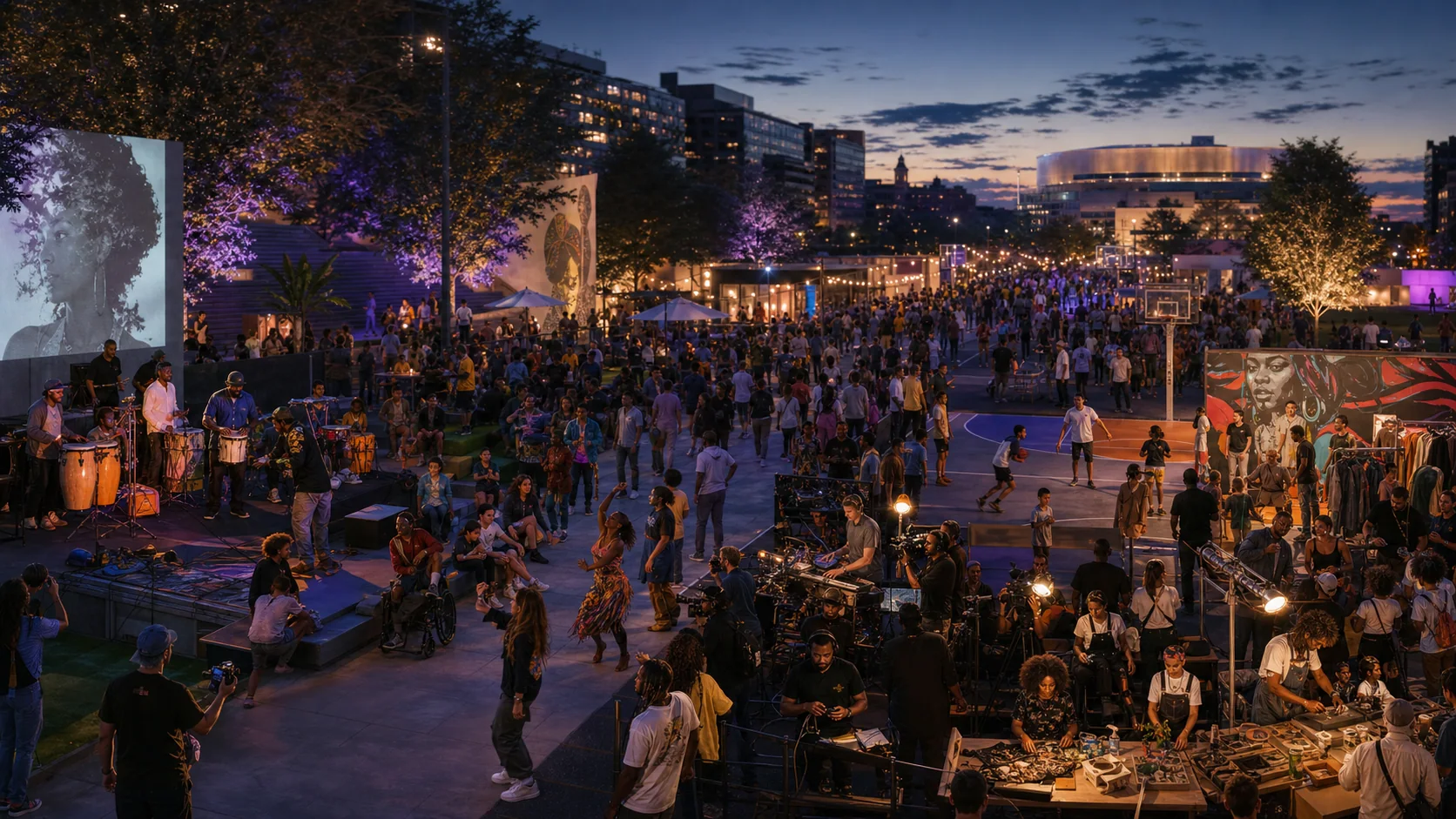
Generated concept visualizations
A welcoming event for the completed arena and a citywide platform for the music, movement, ideas, businesses, neighborhoods, and people that make D.C. matter.
01Illustrative festival conceptScale 01 · Festival welcome
D.C. welcomes the new arena.
The opening program brings music, film, comedy, sport, fashion, food, public ideas, and creative business together in one nationally visible D.C. moment.Illustrative festival concept. Talent participation, partnerships, venue use, and production plans remain unconfirmed.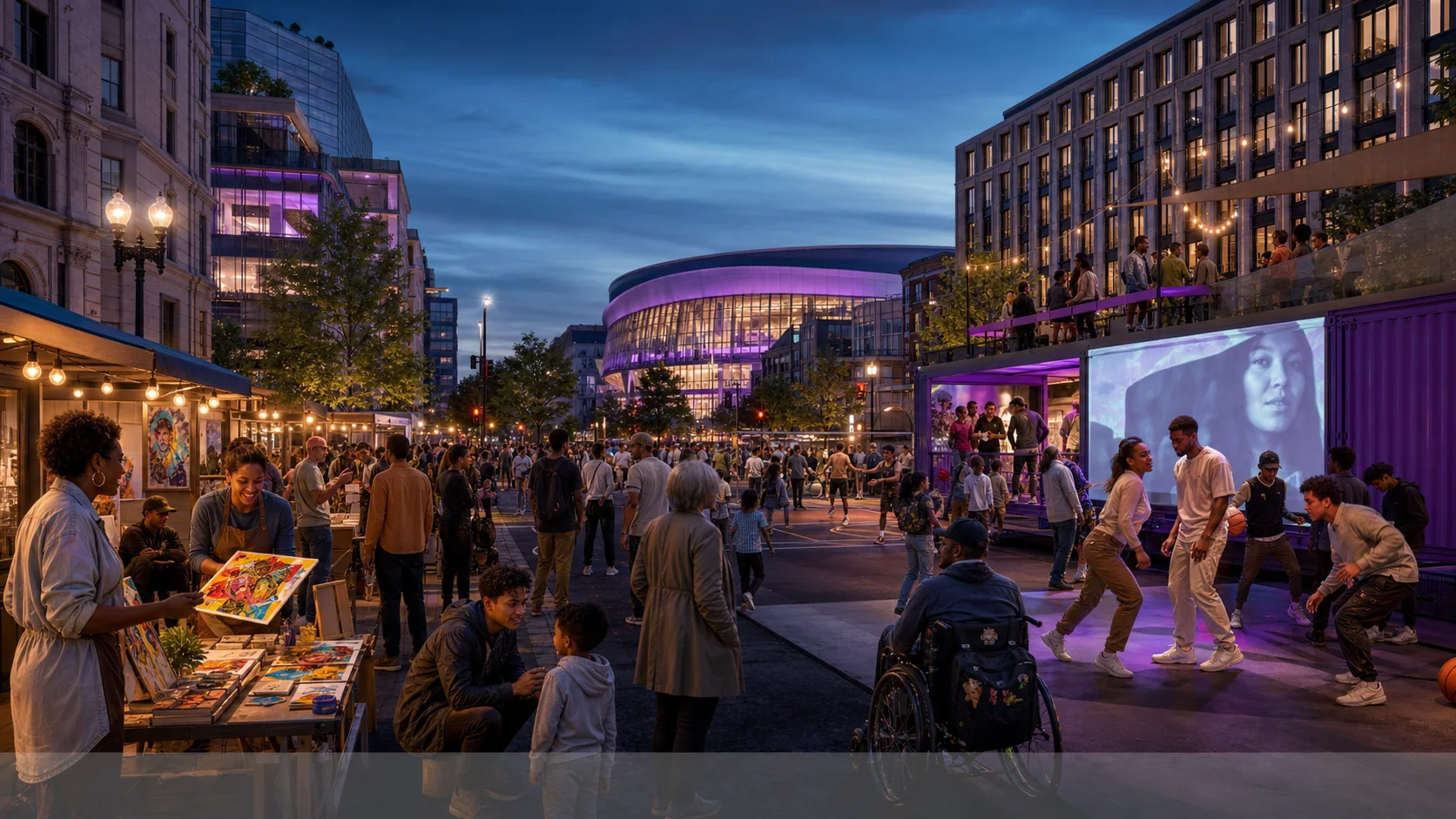 02Illustrative festival concept
Scale 02 · Downtown
The arena opens into the city.
Gallery Place and surrounding streets become a connected field for local retail, hospitality, public space, galleries, smaller stages, and creative business exchange.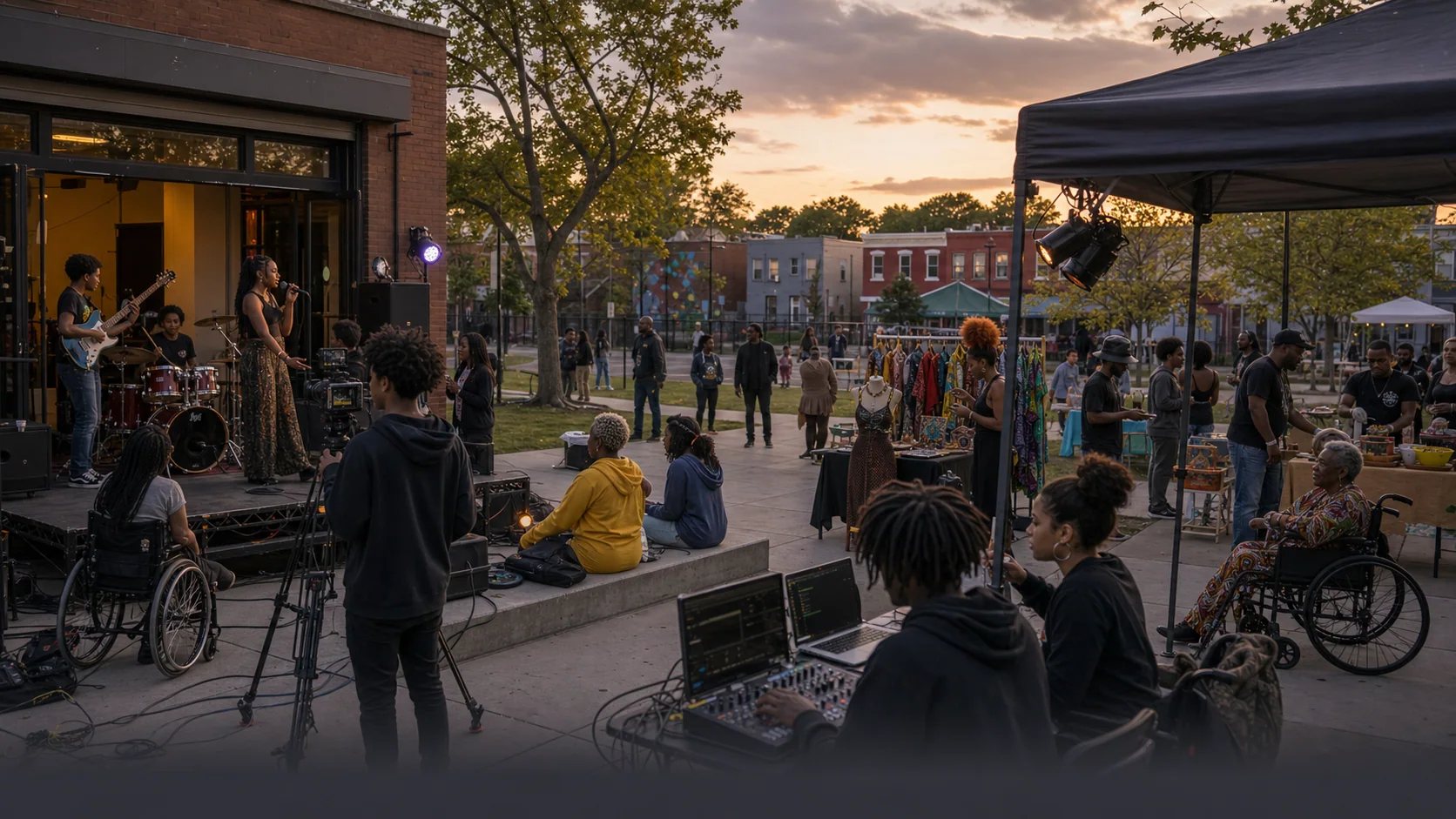 03Illustrative festival concept
Scale 03 · Neighborhood
Each place keeps its own identity.
Paid programming begins with existing venues, local ownership, youth production roles, cultural corridors, and the distinct priorities of each ward.Program architecture
Many disciplines. One economic system.
Crowd composition
Residents before spectacle.
Families, youth, elders, working creatives, visitors, and people with disabilities across price points and access needs.Local business presence
Vendors become part of the institution.
Paid commissions, food and retail, hospitality, production, fabrication, technology, design, and repeat procurement paths.Youth presence
Young people make the work.
Youth appear as paid apprentices, operators, designers, filmmakers, stagehands, founders, and future mentors.The practice behind the proposal
Different forms. One practice.
Building worlds that help people understand, enter, and feel an idea.
Lead proof · 01Media rights pending
City scale convening and brand systems
Bloomberg CityLab
Amsterdam and Washington, D.C. · 2022 and 2023 event yearsRole wording approved · supporting record pendingWashington 2023 verified by Bloomberg CityLab Amsterdam 2022 verified by Bloomberg CityLab
Pierre provided creative direction for the branding and visual experience of Bloomberg CityLab gatherings in Washington, D.C. and Amsterdam.
Precise role
Creative direction for branding and visual experience
Approved deliverables
Creative direction, Branding, Visual experience
DC 2030 relevance
CityLab demonstrates how government, design, policy, technology, and global urban leadership can be held inside one coherent experience.
02
Institutional storytelling and accessible futures
Media rights pendingPortfolio verifiedLocation to confirm · Year to confirm
Smithsonian FUTURES
As part of the core creative team behind Smithsonian FUTURES, Pierre helped shape the project’s visual language through moving image and visual identity across digital and exhibition environments.
Role
Core creative team and visual direction
- Creative direction
- Videography
- Motion graphics
DC 2030 relevance
Pierre Edwards portfolio The work shows an ability to translate complex future facing ideas into emotionally accessible public storytelling.
03
Participatory technology and public space
Media rights pendingPortfolio verifiedFranklin Square Park, D.C. · Year to confirm
Visions of Humanity
Presented in Franklin Square Park, Visions of Humanity used a live camera system, interactive media, projection, and sculpture to blend participants’ portraits into an evolving public artwork.
Role
Creative direction and installation design
- Creative direction
- Installation design
- Interactive media
- Projection design
DC 2030 relevance
Pierre Edwards portfolio The installation demonstrates human centered technology, real time participation, and an inclusive public experience.
04
Regional identity and culturally grounded campaigns
Media rights pendingPortfolio verifiedWashington, D.C. · Year to confirm
Nike Foamposite DMV
Pierre led creative direction for a campaign rooted in the relationship between the DMV, cultural memory, and the Foamposite. The work extended across narrative, visual identity, film, digital strategy, and a Washington pop up.
Role
Campaign and creative direction
- Campaign direction
- Campaign strategy
- Film
- Digital strategy
- Pop up experience
DC 2030 relevance
Pierre Edwards portfolio The campaign demonstrates how D.C. identity can shape a nationally visible story with cultural specificity.
05
Humanizing technology and institutional narrative
Media rights pendingPortfolio verifiedLocation to confirm · Year to confirm
Google Black Summit
Pierre led creative development, narrative writing, film direction, and post production supervision for the Google Black Summit opening film.
Role
Creative development and film direction
- Creative direction
- Narrative development
- Film direction
- Post production supervision
DC 2030 relevance
Pierre Edwards portfolio The work demonstrates how technology and institutional purpose can become emotionally credible cultural storytelling.
06
Stage, spatial design, and Washington storytelling
Media rights pendingPortfolio verifiedThe Kennedy Center, Washington, D.C. · Year to confirm
Wale at the Kennedy Center
For Wale’s Kennedy Center homecoming, Pierre’s work included creative direction, stage design, motion graphics, and fabrication.
Role
Creative direction and stage design
- Creative direction
- Stage design
- Motion graphics
- Fabrication
DC 2030 relevance
Pierre Edwards portfolio The performance demonstrates live production, spatial storytelling, and spectacle rooted in a distinctly Washington narrative.
07
Immersive gathering and emotional architecture
Media rights pendingPortfolio verifiedHi Lawn at Union Market, Washington, D.C. · Year to confirm
Where the Light Falls
Created with DJ Money and presented inside the projection dome at Hi Lawn, Where the Light Falls combined projected visuals, sound, poetry, archives, and atmosphere.
Role
Creative direction and installation design
- Creative direction
- Installation design
- Projection mapping
- Sound curation
DC 2030 relevance
Pierre Edwards portfolio The work demonstrates how image, sound, memory, and environment can create an intimate shared experience at public scale.
Hands on creative leadership
Keep the governing intention alive through delivery.
Pierre would work with the Mayor’s team, agency leaders, community partners, designers, producers, and technologists to create one coherent public experience across selected priorities.
Governing priority
Shared creative direction
Coordinated teams and partners
Coherent resident experience
Three structures for discussion
Choose the structure after defining the work.
Each option supports personal creative involvement with a clear remit, decision rights, and ethical safeguards.
Embedded creative leadership
Pierre serves inside the Mayor’s Office as a senior creative and cultural strategy leader, personally stewarding selected priorities with clear authority and ethical boundaries.
Scoping requirement
Define decision rights, outside activity, recusal, intellectual property, and procurement boundaries.
Executive creative adviser
Pierre works with the Mayor and senior team through a defined advisory structure focused on flagship priorities and cross team coherence.
Scoping requirement
Define remit, deliverables, review cadence, decision rights, and relationships with communications and agency leadership.
External multidisciplinary partner
Pierre’s company provides creative direction and execution through a lawful, transparent, competitive process with an approved scope.
Scoping requirement
Define procurement path, deliverables, intellectual property, partner selection, and conflict safeguards.
Clear roles create trust
Creative leadership works alongside public authority.
Policy and operations
Agency leaders and policy officials retain authority for services, implementation, performance, and resident outcomes.
Public communications
Communications leadership retains responsibility for official messaging, press, routine approvals, and crisis response.
Legal and public authority
Counsel, ethics, budget, labor, accessibility, privacy, and procurement officials define lawful authority and safeguards.
Creative stewardship
Pierre leads the shared narrative, experience principles, prototypes, creative standards, and coherence across selected priorities.
Every structure requires legal, ethics, conflict, intellectual property, employment, budget, and procurement review.
Three horizons
Build trust. Open the door. Earn the institution.
First 100 days
Government people can feel.
- Civic OS prototype
- Focused 311 experience pilot
- Transparent service timeline
- Adoption campaign
- Neighborhood participation test
First year
Opportunity people can enter.
- Creative workforce placements
- Vacant space activations
- Creative economy action agenda
- Institutional partnerships
- Early cultural programming
2028 to 2030
A platform the country recognizes.
- Citywide cultural gathering
- All eight ward participation
- Arena programming
- Local business pipeline
- Workforce pipeline
Illustrative sequencing. Funding, venue use, partner commitments, talent participation, the festival name, and impact targets require confirmation.
Proposed next step
Explore a 90 day scoping process.
A focused process can define the work, test fit, identify dependencies, establish safeguards, and determine the most useful partnership structure.
- 01
Which resident experience should become the first focused pilot?
- 02
Which cultural opportunity programs can begin during the first year?
- 03
Where would Pierre’s leadership create the greatest coherence?
- 04
Which legal, ethical, operational, and procurement boundaries apply?
- 05
Which engagement structure best fits the defined work?
The scoping process would shape a future decision. It carries no commitment to a role, contract, product build, festival, funding, or venue.
One connected public story
Trust becomes a path into possibility.
- 01
A resident reports a broken streetlight.
- 02
The problem is resolved and verified.
- 03
A young resident enters a creative apprenticeship.
- 04
They help produce neighborhood cultural programming.
- 05
They contribute to the citywide festival.
- 06
Years later, they return as a mentor.
This is what it feels like when government puts people first.
DC 2030
A partnership proposal by Pierre Edwards.
Creative direction for governing priorities residents can see, understand, use, and feel.